1) Listen and talk about job sectors and revise vocabulary
2) Learn about modal verbs (grammar)
3) Read about classroom rules abroad
4) Write our classroom rules
5) Exit game
Question: what did you have for breakfast? Did you drink a glass of milk? Have you ever wondered about the process milk has undergone to arrive to your breakfast?
Watch the video and answer the questions:
1) LISTENING COMPREHENSION:
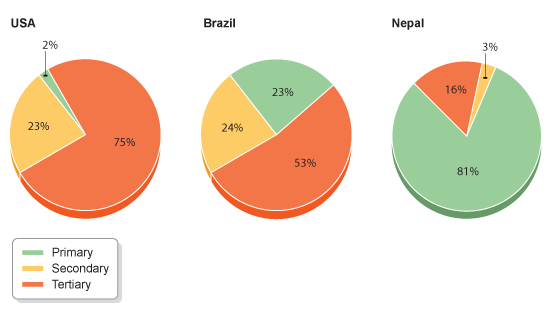
1) Society in terms of work is divided into... a) Primary sector
2) Economy is divided in how many sectors? b) Secondary sector
3) What is work? c) Tertiary sector
4) Fishery belongs to the... d) An activity in exchange for a salary
5) Supermakets belong to the... e) Active and inactive (people who don't work)
6) Factories belonng to the... f) Three
SPEAKING: what is the process for the milk to be on your table this morning?
what is the process for other products? Classify these processes:
a) obtain milk from cows b) buy it at the supermarket c) farmer milks the cow
d) milk is processed in factories e) bottles of milk are transported f) milk is bottled
Could you be a good detective? Challenge yourself with these activities. Don't forget to copy+paste your results in your Powerpoint and create a cover for UNIT 2!
11) Correction of mistakes from your compositions:
- Vary repeated expressions or words which are too generic (this is called use lexical precision): thing, good/bad, people; nowadays; and, or, but; in my opinion, I think that...
1) Watch the trailer ans answer the questions! [LISTENING]. Do you know who is the actress playing the role of a widow? Tell me in you email for an extra CLASSDOJO point!
How are you doing this week? Have you already gone for walk? These are the activities for this week, combining a revision of Unit 5 and 6. Send me the correction of your exercises via email with a screenshot of the final score.
READING: "We face an infinite number of futures". When I was your age we imagined a future with flying cars, teletransportation, and the capacity to minimize objects and keep them in our pockets.
Well... we are still waiting for flying cars but actually, we have sort of seen the other possibilities come true: twenty years ago we had to send a letter, a picture or a film through the post and it would take a long time to get from Spain to, say... New Zealand.
Now, it's just a click away with the internet! Letters have turned into e-mails, photographs have gone digital and you don't need to have a physical tape to watch a film. Isn't it a kind of teletransportation?
Every two minutes, we take as many photos as all of humanity took during the 1800s.
Same with the minimization of objects... Have you got a smart phone? Well, look at the picture below and think about the changes we've had in just a couple of decades!
SPEAKING: Comment on the picture below and imagine how technology would be in 20 years time.
Everything in this 1991 RadioShack ad exists in a single smartphone.
What are the innovations mentioned? Do you agree or disagree? What do you think it will happen? WRITING: Write an essay on this topic: "Technology will control our lives in the future"
Instructions (revise 'your' modals):
You have to structure it into an Introduction, a Body (pros and cons) and a Conclusion.
You don't have to check innovations on the Internet.
You can list advantages and disadvantages of technological innovations
...or you could even invent future gadgets too.
You shall give your opinion. You should not use informal language.
You may include a creative title. You also might include pictures.
You must be punctual. Therefore, you must not be late in give it in!
And remember: you need to double-check your work before printing it off (spelling, tenses, connectors...)
You ought to see the TIPS below!
NOTE: try to work in pairs, one giving reasons in favor of the thesis and the other against it.
TIPS ON FLUENCY (CONNECTORS):
First, write a short paragraph introducing the topic.
Then, try to use these expressions in the body of your composition (ideally two paragraphs: positive and negative effects of technology):
a) On the one hand, on the other hand... firstly, secondly... (to introduce arguments)
b) Furthermore, in addition, moreover (to add information)
c) However, nevertheless (to contradict an argument)
d) For example for instance (to exemplify) To end up you can use:
e) In conclusion, finally, to sum up (to finish)...
f) ... I think, I consider, in my opinion... (to give your opinion)







 So... How do you imagine the future in 20 years? And in 2100? And beyond?